The truck chase
Already exhausted, and now they have to run. Shooting an action sequence in half a day.
This action sequence is about managing the distance between three points: our two main characters, the truck, and the RV. How far apart they are, which way each is moving, and how fast the gaps close.
Our cinematographer, Brennan Full, suggested a Steadicam, since that kind of camera movement suits a chase built on motion and on controlling what is in the frame. She brought in the great Ryan Forte to operate.
Where we were
Poplar Bluff, MissouriIt is a perfectly square crossroads on a farm a couple of miles south of Poplar Bluff, and you can see about a mile in every direction. That presented its own challenge, because it was farming season and everyone was out trying to work. If anyone had been working any of those fields, you would have seen them. It is that vast and that open. The local farmers agreed not to work this area on our day, and we were extremely grateful for it.
That scale is the point. The sequence only works if our two main characters look isolated and lost, and a place like that does half the work for you.
Point of view
Steadicam, lenses, distanceA Steadicam generally wants a wider lens, because a tight one shows every bounce and twist of the rig. Ours was a standard Steadicam, not a motorized gimbal, and our two main characters are running while holding on to each other.
For the wides, no problem. Ryan rides the back of the golf cart, everyone finds their speed and distance, and it works.
The hard part was that I wanted shots where you live with them emotionally, close enough to see the lines land and feel the truck behind them. That is very hard on this setup, and you can see the frame moving in a few of those shots. Ryan and the actors did a fantastic job making them possible.
The wide lens also pushes everything away, like a rearview mirror. The truck had to look fast and out of control, and it never was. It was practiced, with plenty of room. But keep that room on a wide lens and the truck disappears. Meanwhile they have to look like they are approaching the RV as the truck approaches them, and normally a tighter lens does that for you.
A large-budget film would have more money and more time for this scene. It would bring a camera crane, plus stunt performers and stunt rigging, so everything can get closer in the frame and feel more dangerous. We did not have those resources, and we definitely did not have that time. With actors on foot it is always going to be a challenge, so we did it as practically as possible while staying very safe.
The edit solves the rest. I shot it very linear, running straight into the lens and straight away from it, because cutting from front to back lets you manipulate space.
How we shot it
In the order we shot it · south up · half a dayWe had Ryan for that one day, and a dialogue scene was waiting after lunch, so the whole sequence had to go in half a day. We shot it close to the order you see it, camera position by camera position, and the two handheld cameras at the RV came last. Each block below is one camera position: where the camera was, which way it looked, and the shots in the cut that came out of it. South is up on every map, the way we were facing. The sun is where it was, high and to the south, by the time we were running.
All natural light for this scene, as I remember. It was a very bright, windy day.
The cut, shot by shot
18 shots · about 35 secondsHere is what I was asking of each shot, and what the camera is doing.
What I'd do with a second morning
The original planWe had one morning. This is the chase I could shoot in it. My original staging, inspired by North by Northwest, runs twice as long, with the tension building across the same three points.
The original idea had a house in the middle of the field. They run straight across the open ground toward it while the truck has to go the long way round by the road to find the driveway and beat them there. The truck would trace them, coming and going the way the plane does in North by Northwest. That version runs longer and does not start as hot, and I still like it.
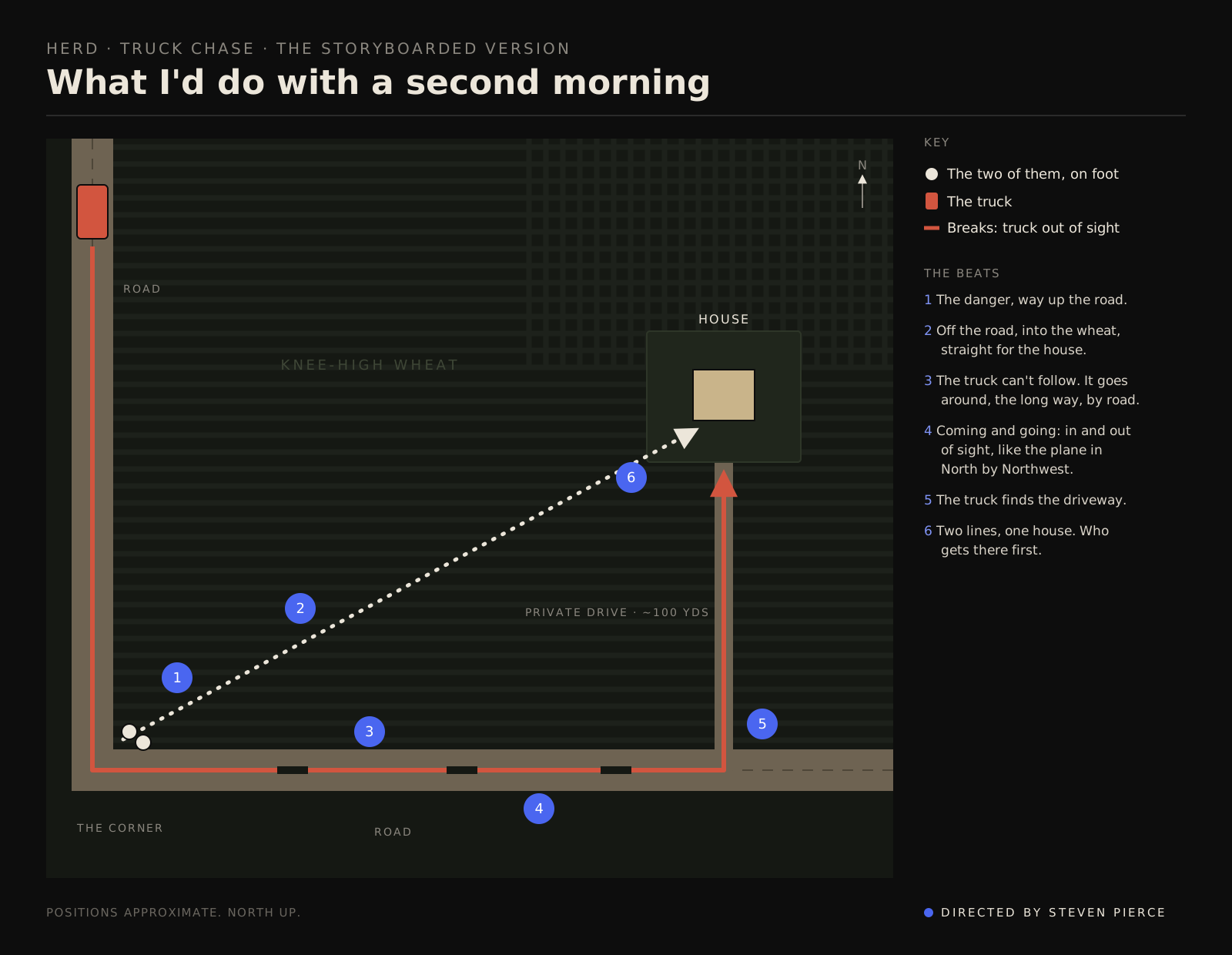
It changed for practical reasons. No location within range of the hotel fit the idea, and with as much as we were shooting each day, a location also needed a house nearby for bathrooms, hair and makeup, and lunch. So we found the crossroads instead, and the crossroads gave us the mile of visibility in every direction. I would not trade that, but I would still like to shoot the field.
The rest of that day
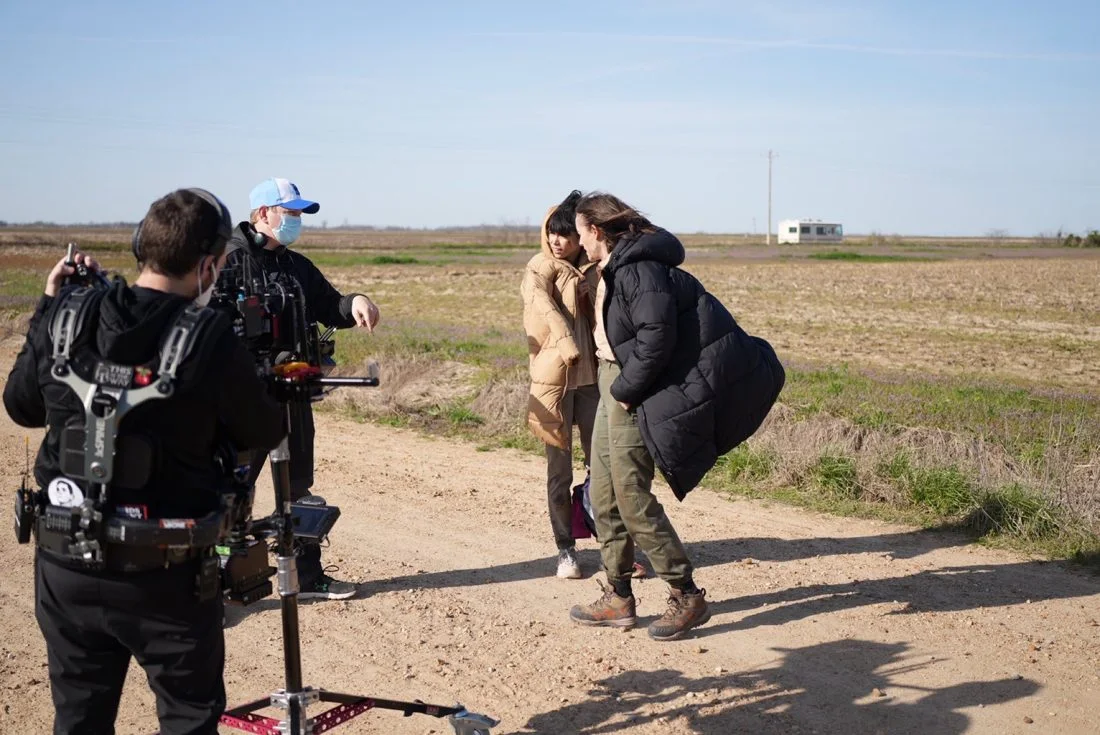
One day on the roadThe chase was only part of that day. The farmers gave us one day when they would not work, so everything on that road had to happen inside it. Before the chase we shot the sequence leading up to it, also on Steadicam, and I love it: the two of them walking down the road through that vast countryside, the truck arriving, and the zombie being killed. Then the chase. Then lunch. Then an entire dialogue scene, all of it in the wind. It was an extremely challenging day, and I think it came out so well. A lot of that is just good fortune.
One more thing
The windIt was one of the windiest days I have ever shot in. We went and bought safety glasses for the whole crew, because you could not see. It was like shooting in a sandstorm. On camera it looks awesome. The wind lifts everything and the whole sequence feels bigger for it. But it was truly one of the hardest days I have had on a set.
We had two days of intense wind on this film, and it was the first time as a director that wind was a real limiting factor for me. I will write another post on how we adapted and what we did about it.
From the day
Behind the scenes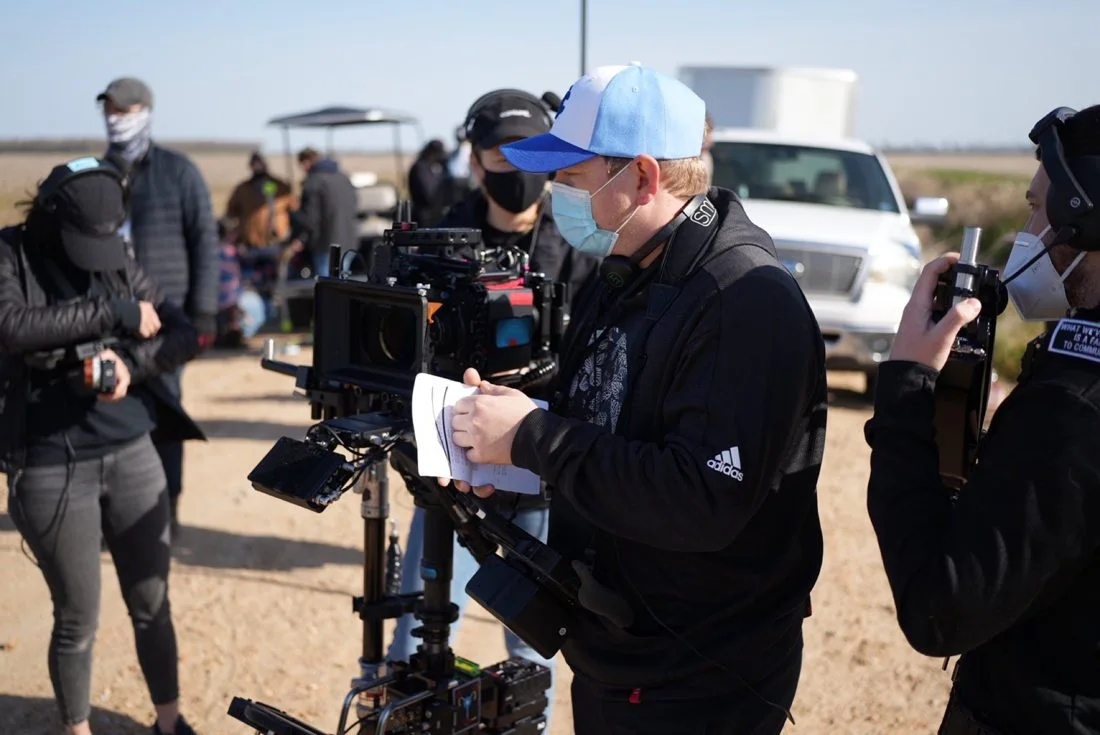
My debut feature. A trip into rural America goes wrong, and the town that takes the couple in does not let them go. World premiere in competition at FrightFest London 2023, US premiere at New York Comic Con, released by Dark Sky Films. 85% on Rotten Tomatoes.
Back to the work- DirectorSteven Pierce @stevencpierce
- WritersSteven Pierce, James Allerdyce
- Cast, this sceneEllen Adair as Jamie @ellenadairg, Mitzi Akaha as Alex @lilmitz_, Jeremy Lawson as Tater @jeremyalawson
- CinematographyBrennan Full @brennan_full
- SteadicamRyan Forte @forteframes
- CameraARRI Alexa Mini, 4K, Zeiss Super Speeds on the Steadicam
- Released byDark Sky Films